A new partnership to shape the future of responsible technology investment and digital infrastructure
On the occasion of the Principles for Responsible Investment (PRI) in Person 2025 conference — one of the world’s foremost UN-backed gatherings of investors representing more than $120 trillion in assets committed to responsible finance — the United Nations Human Rights B-Tech Project and the Project Liberty Institute announced a new partnership to provide a vision for responsible AI investment that does not undermine data agency. The announcement, made during an official side event to PRI in Person in Sao Paulo, comes at a pivotal moment, as responsible investment frameworks expand beyond their roots in climate to address the growing human rights challenges associated with AI and data governance.
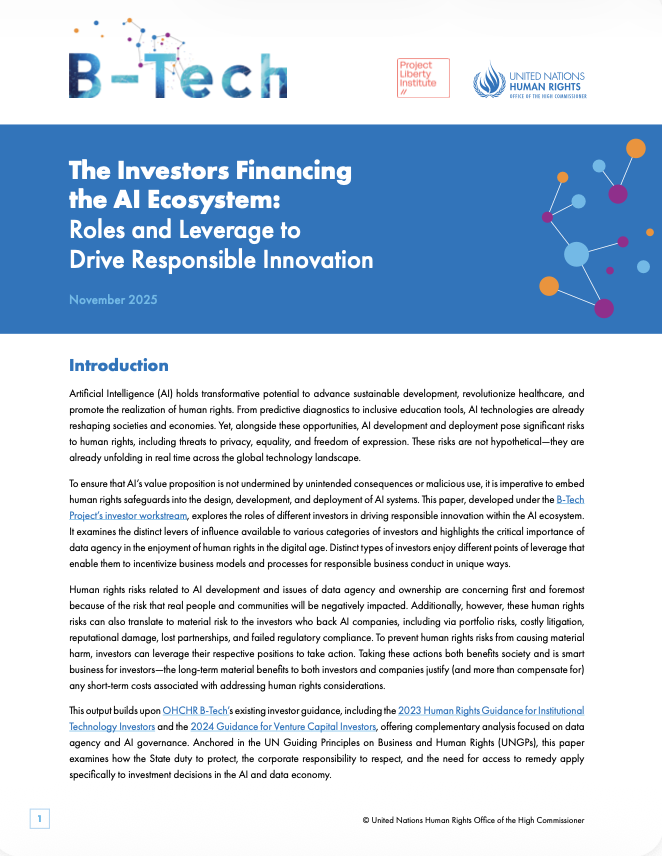
The event also marks the release of a new paper, “The Investors Financing the AI Ecosystem: Roles and Leverage to Drive Responsible Innovation,” jointly authored by UN B-Tech and the Project Liberty Institute. The publication explores how investors can use their influence to align capital allocation with human rights and unlock greater long-term value creation in the process.
This launch kicks off a year-long global process to foster dialogue between among investors in both public and private markets about how to build an AI economy grounded in better business models, stronger digital infrastructure, and respect for human rights.
Why This Initiative Now
Data has become the backbone of the modern economy, the raw material powering AI systems, digital services, and innovation across industries. As these technologies become ever more integrated into daily life, the way data is collected, governed, and shared will define not only economic competitiveness but also the protection of humanl rights.
This paper highlights that data governance and digital infrastructure are at an inflection point. Business models that embed privacy, transparency, and interoperability are increasingly recognized not as constraints but as drivers of innovation, trust, and resilience.
Leaders such as members of Project Liberty’s Fair Data Economy Task Force, including Economics Nobel laureate Daron Acemoglu, have noted that building more open and dynamic data ecosystems can strengthen growth while ensuring that technology remains accountable to society.
This new partnership responds to that opportunity. Its key goal is to produce guidance that equips technology investors with strategies to identify companies whose business models pose data agency-related human rights risks and encourage portfolio companies to mitigate such risks. Investors engaging in this sort of human rights due diligence in their AI investments is an important step toward a next wave of digital infrastructure and AI systems that advances both economic and social progress.
From Guidance to Global Action
Over the next 12 months, UN B-Tech and Project Liberty Institute will convene four regional multi-stakeholder consultations across continents, bringing together investors, policymakers, and technology leaders to co-develop actionable guidance.
The first consultation is taking place on the margins of PRI in Person 2025 in São Paulo (4–6 November), including the official side event “Anticipating and Shaping Responsible Tech Innovation for Ecosystems – Grounding Eco-Augmentation Practices in Human Rights, Data Agency, and Responsible Tech Practices.”
Co-hosted by the UN Human Rights B-Tech Project, the Geneva Science and Diplomacy Anticipator (GESDA), Swissnex in Brazil, and Project Liberty Institute, the event explores lessons learned from existing responsible investment frameworks, particularly climate finance, on how investors can build scalable governance and accountability mechanisms for AI and digital infrastructure.
These global dialogues will culminate in a suite of guidance resources for technology investors, designed to catalyze investment in digital infrastructure in the public interest and embed human rights and data agency in AI governance.
Isabel Ebert, who co-leads the B-Tech Project, and Ben Piler and Stephanie Seale, who developed B-Tech’s investor work, explained:
“This initiative builds on our work to provide technology investors with the tools they need to avoid funding companies that pose serious risks to human rights. Together with the Project Liberty Institute, we are excited to be creating tools that we hope will help to integrate human rights into the investments shaping the AI economy.”
Peggy Hicks, director of the Thematic Engagement, Special Procedures and Right to Development Division of the UN Human Rights Office, underscored the ambition:
“Data agency is key to human rights in the age of AI. This initiative represents a crucial step toward aligning technological innovation with human dignity and the public interest.”
Building Infrastructure for a better AI economy
At its heart, this partnership is about encouraging investment in a more trustworthy and inclusive digital economy, one in which respect for human rights and data agency, reinforce competitiveness rather than constrain it.
Sheila Warren, CEO of Project Liberty Institute, emphasized:
“Focusing on data agency and digital infrastructure is key to building a digital economy that recognizes that it is ultimately human beings who make up markets. We’re delighted to partner with UN B-Tech on this next phase of work to turn responsible innovation into global practice.”
Complementing the Global Responsible Investment in AI Processes
The partnership with OHCHR builds on and complements the existing Responsible Investment in AI process led by Project Liberty Institute in cooperation with ReframeVenture, and Omidyar Network, which have already engaged more than 60 limited partners representing over $6 trillion in assets under management.
Paul Fehlinger, Director of Policy, Governance Innovation & Impact at Project Liberty Institute, who leads its strategic engagement with investors, said:
“Public and private investors are looking for clear guidance on what responsible AI looks like. This collaboration with UN B-Tech will be crucial in advancing our shared understanding of what ‘good AI’ means and how to invest in it.”
It also connects to the new venture-capital stream on Responsible and Impactful Investment in AI, developed by Project Liberty Institute, ReframeVenture, and ImpactVC, which mobilizes leading investors across Europe, North America, and Asia to define what “good AI investment” looks like in practice.
Together, these complementary work streams form a coherent global effort to align the incentives of institutional and venture investors with the principles of data agency, responsible innovation, and long-term value creation.