
On November 13, 2025, the Project Liberty Institute (PLI), in collaboration with its strategic partners ReframeVenture, Omidyar Network and ImpactVC, convened one of the most significant investor gatherings to date on the future of responsible investment in artificial intelligence and data technologies. Held at Stanford University in Palo Alto, the Stanford Summit Responsible Investment in Data & AI brought together a powerful cross-section of leading technologists and the investment ecosystem, including leading limited partners (LPs) and venture capitalists (VCs) representing more than four trillion [$] in capital across the United States and Canada.
The event created a rare forum for asset owners, allocators, and governance leaders to discuss how capital can shape AI technologies in ways that advance human agency, uphold democratic values, and strengthen long-term market trust.
The day began with a welcome from Dr. Johannes Lenhard of ReframeVenture, Paul Fehlinger of the Project Liberty Institute, Priya Shanker of Stanford University, and Chris Jurgens of Omidyar Network. Together, they framed the day’s purpose: to advance a shared conversation on responsible investment in AI and data, and to equip LPs and VCs with the framework needed to navigate today’s rapidly evolving technological landscape.
The following conversation brought together Nancy Pfund, Founder and Managing Partner of DBL Partners, Mike Kubzansky, Chief Executive Officer of Omidyar Network, and Douglas Sloan, Managing Director, Impact, at Better Society Capital and founder of ImpactVC. Their dialogue focused on the potential of data and AI to drive positive social and economic outcomes, while underscoring the role investors can play in guiding innovation away from extractive models and toward those that benefit markets and communities.
In the early afternoon, participants moved into the first set of breakout discussions that were facilitated by prominent LPs, VCs, and governance experts. One session examined whether AI-driven productivity gains ultimately augment society or create new risks through automation. Another explored how investors should approach questions of data privacy, human agency, and user rights as material drivers of long-term value. Both sessions stressed that investment decisions taken today will significantly shape how AI is developed and deployed across the economy.
The second set of breakout sessions evaluated an area of public concern–domains. One session focused on AI, data, and surveillance and asked whether responsible approaches are possible in sensitive contexts. The other explored the intersection of AI and climate, including what a just transition might look like as AI accelerates or reshapes the sustainability agenda.
The discussions reaffirmed that responsible investment requires proactive governance, informed oversight, meaningful stakeholder engagement and a forward-looking vision of how AI can reinforce rather than undermine societal and market resilience.
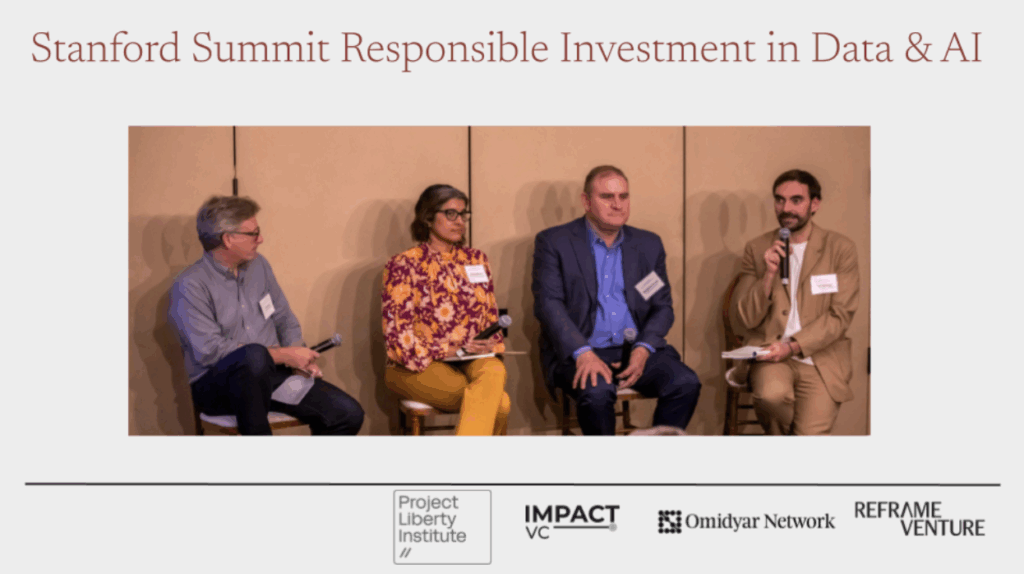
The day concluded with a panel of leading investors, including Jonathan Duckles, Partner and Deputy General Counsel & Head of Fund Transactions at SoftBank Investment Advisers; Suzanne Tavill, Partner and Global Head of Responsible Investment at StepStone Group; Lenore Champagne Beirne, Founder and Managing Partner of Bright Ventures; and Johannes Lenhard, Co-Founder and CEO of ReframeVenture. Their conversation focused on concrete next steps for LPs, VCs and founders seeking to integrate responsible AI and data governance into their due diligence processes, portfolio management strategies and innovation roadmaps.
Reflecting on the summit, Paul Fehlinger, who leads PLI’s global investor engagements, underscored the strategic importance of long-term alignment across the entire capital stack.
“If we want AI to evolve in ways that strengthen economies and societies, we need a far more coordinated investment architecture,” he noted. “Sustained, structured dialogue between asset owners and allocators is how we build a shared vision of what ‘good’ looks like at the innovation frontier. The signals are clear: the investors who shape the governance of AI today will not only define the markets of tomorrow, they will also be best positioned to capture the most resilient and scalable value creation in the decade ahead.”
The Stanford Summit represents an important milestone in PLI’s expanding global investor-engagement initiative and builds on previous meetings in Paris, New York, Cape Cod, Singapore, London, and Tokyo. In partnership with ReframeVenture, Omidyar Network and ImpactVC, PLI is advancing a multi-year process that brings together LPs, VCs and, important ecosystem organizations to catalyse shared governance, investment and innovation frameworks for a more trustworthy AI and data economy that puts human agency at the center. This work now spans several continents and includes a newly launched collaboration with the United Nations B-Tech initiative focused on data agency as a human right across public and private market investments in AI.
Together, these efforts reflect PLI’s conviction that building a better digital future requires aligned incentives, coordinated governance, and a shared, evidence-based north star across the entire stack of actors shaping the next era of technological innovation.