AI is the most consequential investment theme in global venture capital. One of the defining questions of our time is how is capital is deployed and whether it flows toward AI that serves human interests or concentrates power in ways that undermine them. Project Liberty Institute [PLI] spent the past two years building infrastructure to help investors answer that question. This month, that work reached two of Asia’s most important financial capitals.
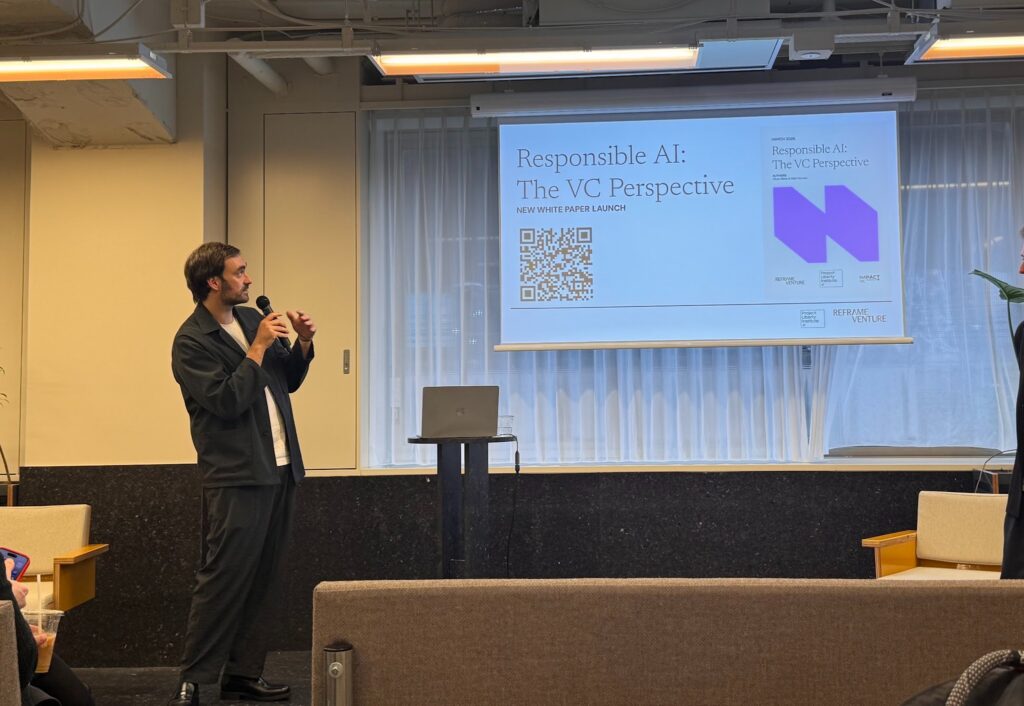
Paul Fehlinger presenting findings from the white paper, Responsible AI: The VC Perspective.
Building Momentum
Through joint work with ReframeVenture and ImpactVC, and in partnership with the UN Human Rights B-Tech Project and Omidyar Network, PLI engaged institutional LPs and VCs collectively representing more than six trillion USD in assets under management on the future of investing in AI.
A white paper released jointly with ReframeVenture and ImpactVC found that nine in ten VC investors see financial opportunity in a responsible AI stack. A first-of-its-kind due diligence toolkit developed alongside the white paper is already equipping investors in their daily decisions.
Last November, PLI and UN B-Tech released a companion white paper, “The Investors Financing the AI Ecosystem: Roles and Leverage to Drive Responsible Innovation,” launching a series of cross-regional consultations to update UN investment guidance on AI, human agency, and rights. Those conversations have spanned New York, Silicon Valley, Paris, Berlin, London, and São Paulo.
Seoul: AI as Value Creator or Value Risk?
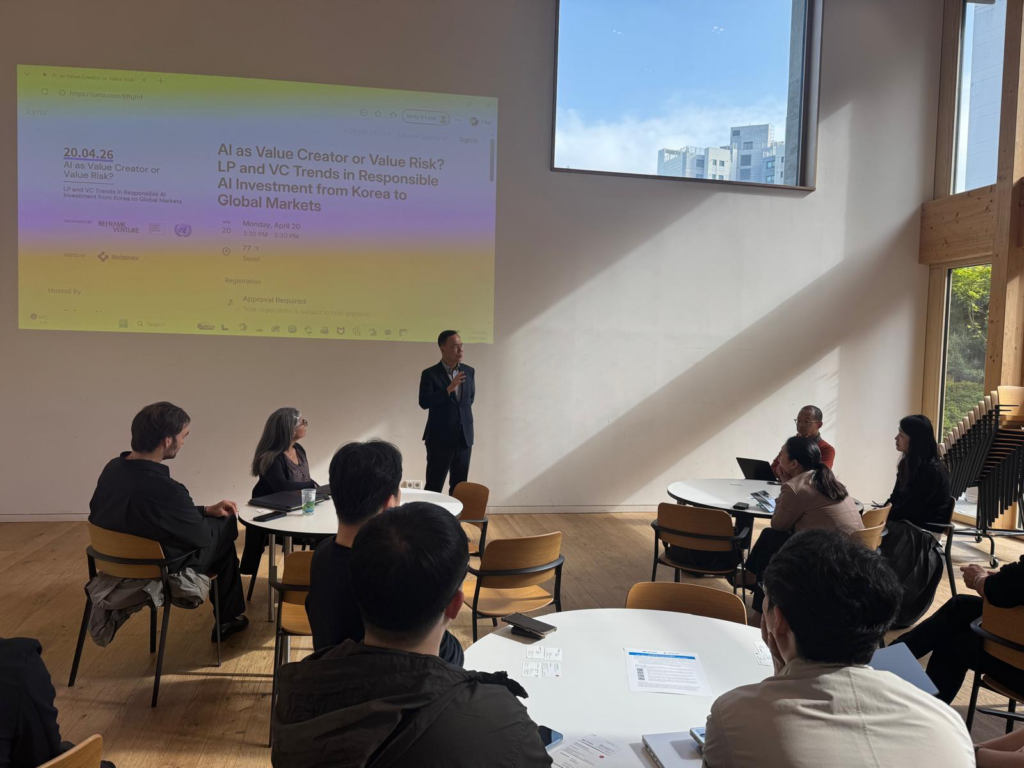
Former Korean IT Vice Minister Wonki Min giving opening remarks at PLIxUN B-Tech Korea consultations at the Swiss Embassy.
On April 20th, PLI joined ReframeVenture and UN B-Tech for a roundtable hosted by the Swiss Embassy in South Korea. Switzerland will also host the next global AI Action Summit in 2027. Around two dozen Korean asset owners, venture capital investors, technology leaders, and policymakers gathered to examine a central tension in today’s investment landscape: AI’s promise as a driver of growth sits alongside material risks no serious investor can ignore including governance failures, loss of agency, data-driven market concentration, human rights exposure, and systemic labour market impact.
The session offered Korean investors comparative insights drawn from worldwide engagements, while creating a safe space for the Korean ecosystem to exchange on future direction and contribute to the global processes to advance responsible AI investment. The session fed directly into ongoing UN B-Tech and PLI regional consultations that brought together stakeholders at the UN Headquarters in New York and on the sidelines of the PRI annual meeting in São Paulo. European engagements are to follow.
“Korea and Japan are critical players in shaping the trajectory of responsible AI investment,” said Paul Fehlinger, Deputy Director of Project Liberty Institute. “Both have sophisticated capital markets, deep technology foundations, and the institutional capacity to translate responsible investment principles into practice at scale. As middle powers with the political will to define AI development that preserves human agency, they bring something essential to the global conversation: the ability to bridge emerging market realities and advanced economy standards. Their investors need to be at the table where the norms are being written.”
Tokyo: Two Conversations, One Direction
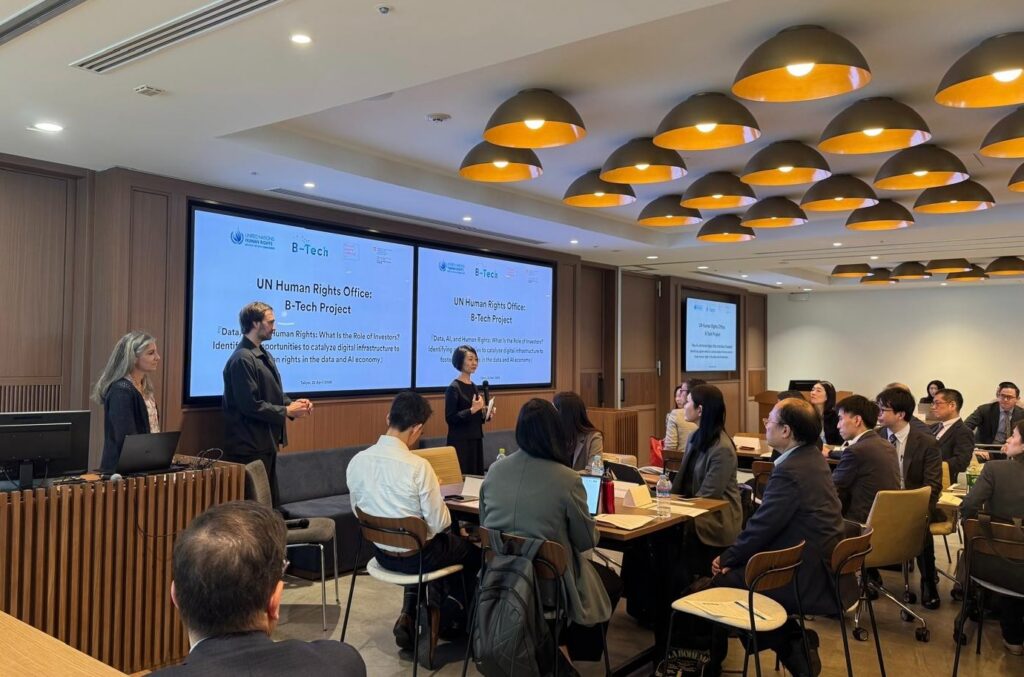
UN x PLI Tokyo Consultations co-hosted with the Swiss Embassy
The sequential days brought PLI to Tokyo for SusHi Tech, Tokyo’s flagship startup and innovation conference where PLI co-hosted with UN B-Tech and the Science and Technology Office of the Swiss Embassy in Japan a closed-door roundtable, “Data, AI, and Human Rights: What Is the Role of Investors?” Held under Chatham House rules, the consultations convened public and private markets investors, civil society organisation, academics, and policymakers.
Three structured sessions moved from the landscape of data-related human rights risks, to investor approaches to due diligence, and a practical discussion of what guidance materials actually change behavior. Discussions focused on questions increasingly on investors’ minds: Is responsible data governance a compliance overhead or a value driver? Is the transition toward human centered AI business models where the most resilient long-term returns will be found?
UN B-Tech x PLI Tokyo Consultations
On the third day of the convenings, PLI joined ReframeVenture to co-host an LP/VC Summit titled “All Things Responsible Investing” at the ø Club.
Continuing conversations from prior Summits in Silicon Valley and New York with Omidyar Network, the session brought together leading Japanese institutional asset owners and VC partners to engage on responsible AI and the evolving investment landscape in Japan. The discussion anchored in recent findings from the ReframeVenture x PLI x ImpactVC White Paper on Responsible AI. The most notable finding from the white paper concluded that nine out of ten VCs see financial opportunity in a responsible AI stack.
The closing panel, moderated by Paul Fehlinger, discussed whether responsible AI is emerging as a defining vector for APAC venture, and how Japanese LPs and VCs are thinking about human agency in AI systems from a downside risk lens and as an investable opportunity to address prevailing adoption and trust constraints.

Paul Fehlinger moderating the panel on the future of AI with Yuka Hata of Japan Investment Cooperation, Keisuke Nakatsuka of B Captial and Simon Hirtzel of IQ Capital at the ReframeVenture x PLI Tokyo LP/VC conference.
Why Asia, Why Now
The norms governing responsible AI investment are durable only if they are adopted across regions. Asia’s institutional investors, sovereign funds, and venture ecosystems have both the scale and the incentive to shape norms. Asian investors deserve a seat at the table where standards are being written. The conversations in Seoul and Tokyo facilitated by PLI will directly inform the work of the ReframeVenture network on LP/VC frameworks and the next iteration of UN B-Tech investor guidance that advances the definition of pro-human AI through the lenses of human rights due diligence and financial materiality.