At the Project Liberty Institute (PLI), our mission is to expand people’s voice, choice, and stake in the data and AI economy across the full stack, from capital and entrepreneurship to digital infrastructure and enabling policy. As artificial intelligence reshapes economies and democratic systems, building shared understanding among policymakers has become an essential part of that mission.
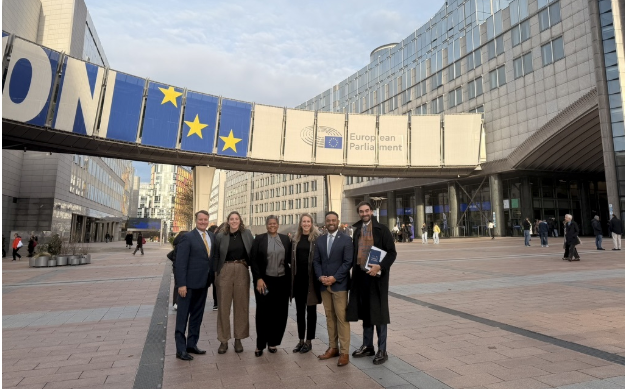
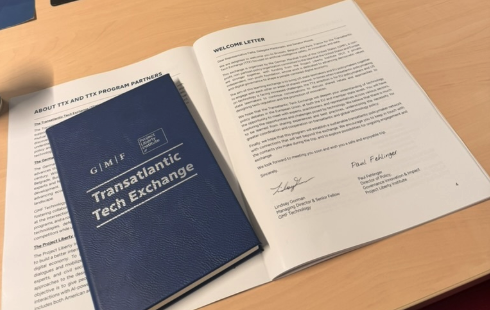
PLI was proud to partner with the German Marshall Fund of the United States (GMF) to facilitate the first structured exchange between U.S. state-level policymakers from both parties and leading European actors across the AI value chain. The inaugural Transatlantic Tech Exchange from the US to Europe, held December 8-12 in Brussels and Paris, was supported by PLI and forms part of a broader cooperation between GMF, the Project Liberty Institute, and Stiftung Mercator, a new partnership first announced by PLI founder Frank McCourt at the GMF.
A Moment for Transatlantic Alignment
The exchange was designed to address a shared challenge: how democratic societies can govern AI in ways that strengthen innovation while safeguarding rights, economic opportunity, and open digital ecosystems. Across both cities, participants explored where U.S. state-level approaches and evolving EU frameworks converge, where they diverge, and where collaboration can meaningfully shape the future of the AI economy.
The U.S. delegation included Representative Doug Fiefia (Republican, Utah), Delegate Michelle Maldonado (Democrat, Virginia), and Senator Michael Moore (Democrat, Massachusetts). All three lawmakers serve on a bipartisan national US task force focused on artificial intelligence and cybersecurity.
Lessons from Europe’s AI and Data Architecture in Brussels
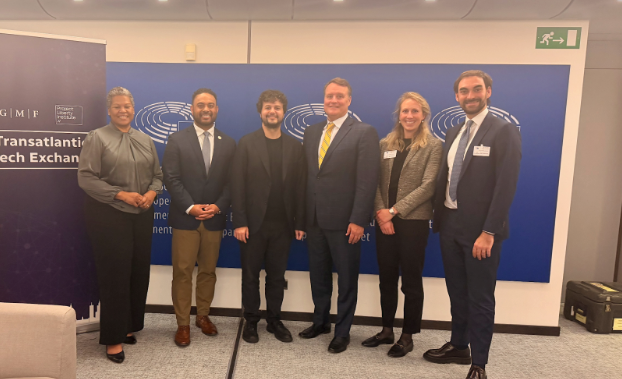
The Brussels program began with a strategic orientation on Europe’s AI and data policy landscape, including the EU AI Act, the Digital Omnibus proposal, and broader continental innovation priorities. Policymakers then engaged directly with:
- The European Commission’s AI Office: meeting Director Lucilla Sioli and senior officials on implementation and enforcement of the AI Act.
- DG JUST: discussing fundamental rights, international data flows, and the role of data protection in AI governance.
- European Parliament leaders, including Eva Maydell (EPP), who shared perspectives on competitiveness and transatlantic research ecosystems; Brando Benifei (S&D), lead rapporteur for the EU AI Act; and Damian Boeselager (Volt), who discussed Europe’s data strategy and the implementation of the Data Governance Act.
Civil society experts from CDT Europe, EDRi, and AI Collaborative added further depth, highlighting enforcement challenges, rights-preserving AI approaches, and the importance of a human-centric digital infrastructure.
Themes that surfaced repeatedly included: ensuring trustworthy AI models, enabling secure digital identity and wallets, unlocking data for innovation while preserving privacy, and strengthening protections for young people online.
Innovation Ecosystems and France’s National AI Strategy

In Paris, the delegation explored France’s rapidly advancing AI landscape. Discussions with French policymakers included:
- MP Eric Bothorel, a longstanding leader on data, telecoms, and AI public policy.
- Anne Bouverot, France’s Special Envoy for AI, on the national AI strategy and outcomes of the Paris AI Action Summit.
- The Ministry of Economics, Finance and Industrial and Digital Sovereignty, focusing on innovation, competitiveness, and emerging technologies.
These conversations highlighted shared priorities around responsible innovation, the modernization of digital infrastructure, global competitiveness, and building data markets that enable value creation without reinforcing extractive models.
Strengthening Transatlantic Dialogue on AI and Data Policy
The goal of the exchange is not only to deepen understanding, but to build a lasting and trusted network of policymakers committed to advancing democratic values in technology governance.
Reflecting on the week, Paul Fehlinger, PLI’s Director of Policy, Governance Innovation & Impact, noted
Even as the political landscape becomes more complex, the United States and Europe remain deeply interconnected markets when it comes to AI and data. Policymakers on both sides of the Atlantic are grappling with closely related opportunities and risks, from innovation and competitiveness to safeguards and trust. Against this backdrop, transatlantic exchange on these issues remains of high importance. As the broader context continues to evolve, the conversations highlighted substantive points of alignment that can contribute to an innovative and responsible AI economy.
PLI looks forward to continuing this work with partners across the U.S. and Europe, helping build the policy, infrastructure, and investment frameworks needed for a more human-centric AI and data economy.