Project Liberty Institute at the India AI Impact Summit
On February 16-20, Project Liberty Institute was in New Delhi for the AI Impact Summit, the leading global event on AI convened by the Government of India to strengthen international cooperation around ensuring AI delivers broad public benefit.
Over the course of an intense and energizing week, Project Liberty Institute delegation, led by President Tomicah Tillemann, with Policy & Research Manager Sarah Nicole and Strategic Insights Manager Jessica Theodule, engaged across four distinct sessions: a main summit panel, two invitation-only governance roundtables, and a public workshop. Together, these convenings brought together a remarkable cross-section of policymakers, technologists, civil society leaders, and diplomats united by a shared conviction: that AI governance is too consequential to be left to any single country, company, or community.
The week reinforced what we already believe: the path to a pro-human, AI future runs through coalitions built across strategic middle powers and multilateral institutions such as this convening.
Building Trusted Digital Infrastructure Fit for the AI Era
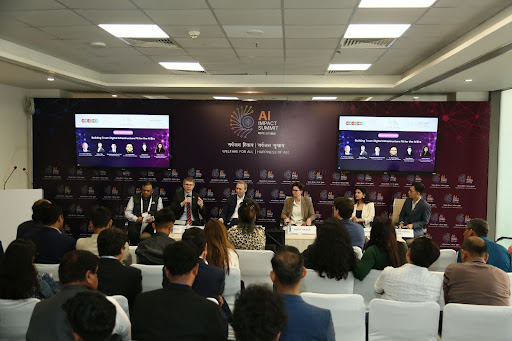
On February 16, PLI led a main-stage session titled “Building Trust: Digital Infrastructure Fit for the AI Era,” co-organized with the Stanford Institute on Human-Centered Artificial Intelligence (HAI) and the Global Solutions Initiative. The panel drew over a hundred participants and brought together some of the most influential voices shaping AI policy across the Global South, international institutions, and the safety research community.
PLI President, Tomicah Tillemann ,was joined by Dr. Arvind Gupta, Co-Founder of the Digital India Foundation and a trusted advisor to Prime Minister Modi, Robert Opp, Chief Digital Officer at UNDP; Dr. Supheakmungkol Sarin, Co-Founder of AI Safety Asia, and Vidisha Mishra, Director of Global Outreach and Policy at the Global Solutions Initiative. The discussion was moderated by Sarah Nicole.
The conversation explored how AI is fundamentally reshaping sovereignty, for individuals, communities, and nations alike, and what it will take for governments to align AI innovation with the public interest rather than narrow commercial or geopolitical agendas. The energy in the room was unmistakable. There is genuine global appetite for technology and governance frameworks that put people first.
The Road to AI Summit Switzerland 2027
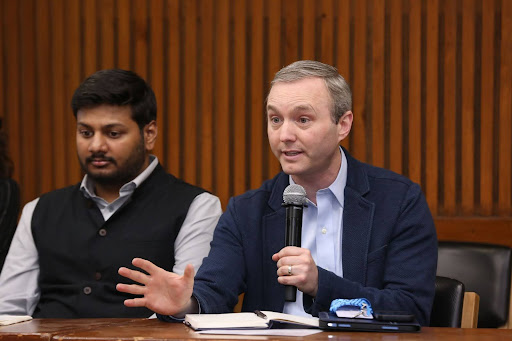
On February 17, PLI convened a multistakeholder roundtable in partnership with Chatham House, the Global Solutions Initiative, and Aapti Institute, focused explicitly on formulating recommendations for the upcoming AI Action Summit in Switzerland in 2027. The group included some of the sharpest minds working at the intersection of AI, open knowledge, and international policy.
Key participants included Anna Tumadóttir, Chief Executive Officer of Creative Commons, Joseph Carroll, Head of the AI Unit at the UK Foreign, Commonwealth & Development Office, Henri Verdier, General Director of the INRIA Foundation and former French Ambassador for Digital Affairs, and Benjamin Prud’homme, Vice-President for Policy and Global Affairs at Mila.
The quality of conversation matched the caliber of the room. There was a clear appetite in the room to bridge geopolitical divides and to build trust through bottom-up, regionally rooted models. The focus on practical action and “unconferencing” models that allow for more bottom-up participation with concrete outcomes was also a thread throughout the discussions and the summit itself.
Diplomacy in Action: A Governmental Roundtable on Steering DPI and AI Toward Public Value
In Delhi, on February 18, PLI co-hosted an invitation-only roundtable alongside the Australian Department of Foreign Affairs and Trade and IT for Change. The session brought together an extraordinary group: the Austrian Secretary of State for Digitalization, the Austrian Ambassador to India, representatives from Cambodia, Finland, Brazil, South Africa, and India, as well as leaders from global organizations.
The discussion focused on the policy and institutional frameworks governments can use to ensure that digital public infrastructure and AI genuinely serve public value, and not merely the platforms and corporations that build on top of them. The presence of key national governments in the same room, comparing notes and finding common ground, was itself a demonstration of the multilateral momentum that responsible AI governance requires.


Building a New Social Web between Protocols, People and the Promise of a Democratized AI-Data Economy
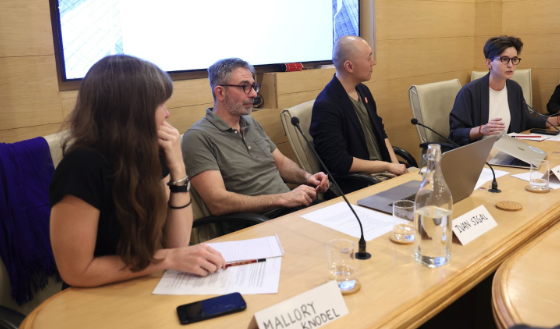
The week concluded with a public workshop on AI and the social web, held at the Observer Research Foundation. Co-organized with the Social Web Foundation, Public AI, and the Modal Foundation, the event launched the first session in a global workshop series exploring how open social protocols can safeguard user sovereignty in an AI agent-mediated web. Lead discussants included Mallory Knodel, Executive Director of the Social Web Foundation, Joshua Tan, Co-Founder of Public AI, and Ivan Sigal, Co-Founder of the Modal Foundation and Interim Executive Director of Free Our Feeds.
The workshop asked, who controls the infrastructure of our social lives online, and what happens to that question as AI agents increasingly mediate our digital interactions? The conversation that followed was the richest of the week– practical, technically grounded, and genuinely cross-sectoral.
New Delhi made one thing clear: there is a clear appetite for alignment on building tech solutions and governance frameworks that puts people at the center. The India AI Impact Summit brought together governments, technologists, civil society leaders, and international organizations who understand this urgency and are prepared to act on it.
Among the key insights and recommendations we are taking back from Delhi are:
- Build an Alternative AI Stack grounded in transparency, accountability, and human flourishing
- AI and digital infrastructure are seen as two sides of the same coin, highly strategic and the true battle for compute, connectivity, and innovation
- Prioritize assurance mechanisms, certification, auditing, and oversight, alongside regulation
- Strengthen digital commons and open standards to reduce the concentration of power
- Move from high-level dialogue to operational implementation
Project Liberty Institute is committed to sustaining and deepening the relationships forged in New Delhi, carrying the insights from this week into the lead-up to AI Summit Switzerland 2027 and beyond. The coalitions we build now will shape the digital infrastructure that shapes all of us. We are grateful to every partner, participant, and panelist who made this week possible.