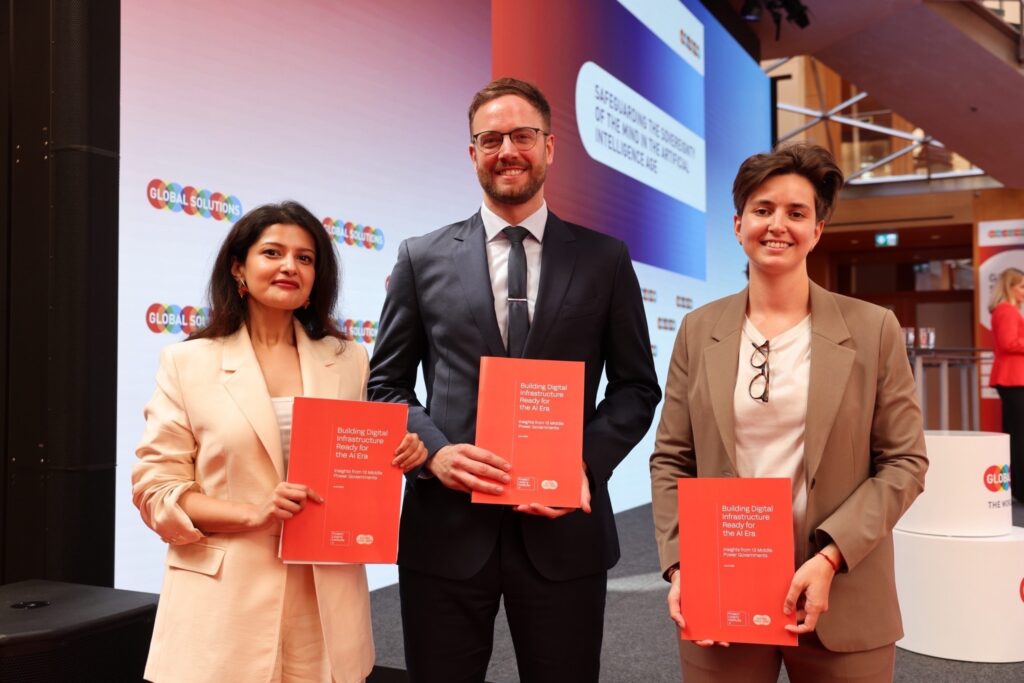
Project Liberty Institute and the Global Solutions Initiative are pleased to release Building Digital Infrastructure Ready for the AI Era: Insights from 13 Middle Power Governments.
View or download the report as a pdf here.
Digital infrastructure has quietly become the primary lever through which governments shape outcomes in the AI era. How a country designs its national digital stack — its identity systems, data exchanges, connectivity layers, interoperability standards — is increasingly a fundamental act of governance, not a technical procurement decision.
This report is the product of a year of in-depth interviews and survey insights with government officials across 13 countries: Brazil, Cambodia, Canada, France, Germany, Greece, Indonesia, Japan, Kenya, Mexico, Senegal, South Africa, and Switzerland.
Spanning five continents, these countries were selected for their significant AI research capacity, democratic governance frameworks, and economic weight — as G20 members or middle powers, as illustrated in the now famous Davos speech from Prime Minister Carney.
Rather than recommending a single model, the report surfaces patterns, trade-offs, and points of divergence that allow governments to learn from one another as part of an emerging community of practice.
The key finding from these government interviews and surveys is that no government believes AI full-stack national sovereignty is possible. The costs are too high, the talent too scarce, the infrastructure demands too great for any single middle power to absorb unilaterally. Regional frameworks and collaboration are developing, but slowly — and there is still nothing meaningful at the global level. The cost of continued isolation is compounding: duplicated investments, incompatible standards, and deepening dependence on a small number of dominant platforms.
Sovereignty increasingly means openness and collaboration, not isolation. The countries pursuing the most durable forms of digital independence are doing so through open standards, interoperable architectures, and strategic use of open-source technologies — not through attempts at full technological self-sufficiency. A system built on open, portable foundations retains the flexibility to adapt. One built on proprietary dependencies often does not.

This report offers an honest account of where governments actually stand — their blindspots, their trade-offs, and the opportunities they are beginning to recognize. We invite policymakers, academics, and civil society to engage with our findings.